

Cat Scratching Post: How to Choose the Right One
Table of Contents
- Why Every Cat Needs a Scratching Post
- Types of Cat Scratching Post: Which Format Suits Your Cat?
- Sisal vs Carpet Cat Scratcher: Which Material Lasts Longer?
- Cat Scratching Post Height Requirements Explained
- How to Train a Cat to Use a Scratching Post
- Stability, Safety and Multi-Cat Household Considerations
- Conclusion
Last Updated: August 26, 2026
A cat scratching post is one of the most important purchases you'll make for your cat's long-term health and your furniture's survival. At Pet Care Online, we hear from cat owners regularly who've bought the wrong post, watched their cat ignore it completely, and returned to find claw marks running down the sofa. The good news: choosing the right post isn't complicated once you understand what cats actually need from one.
Below, we'll cover every format, material, and sizing consideration worth knowing, plus the training techniques that genuinely work. The placement strategy alone changes everything for cats that seem uninterested.
Why Every Cat Needs a Scratching Post
A cat scratching post isn't a luxury item. It's a functional necessity tied directly to how cats are wired to behave. Cats that don't have an appropriate outlet for scratching will find one themselves, and it's rarely the one you'd choose for them.
Claw Health and Natural Instincts
Scratching is how cats maintain claw health. The motion strips away the outer sheath of the claw, exposing the sharper layer beneath. Without this, claws can become overgrown, curved, and painful. According to RSPCA Australia's cat care guidance, scratching is a core natural behaviour for cats and suppressing it entirely causes stress and physical discomfort.
Vertical scratching, in particular, engages the full muscle chain from the paw through the shoulder. It's a stretching mechanism as much as a claw maintenance one. Indoor cats especially rely on a cat scratching post to replicate the physical engagement they'd get outdoors on bark and timber.
Stress Relief and Territorial Marking
Scratching also serves a territorial function. Cats have scent glands in their paw pads, so when they scratch a surface, they're leaving both a visual mark and a scent signal. This is why cats often scratch near entry points, windows, or areas where other animals have been.
For indoor cats, providing a designated cat scratching post in the right location gives them a sanctioned outlet for this territorial behaviour. Cats that can't express it appropriately tend to show increased anxiety and redirected aggression. A well-placed post isn't just furniture protection; it's cat enrichment that supports genuine psychological wellbeing.
Types of Cat Scratching Post: Which Format Suits Your Cat?
The format of a cat scratching post matters more than most owners realise. Cats have strong preferences, and a post that doesn't match your cat's natural scratching posture will be ignored regardless of the material.
Vertical Posts and Cat Towers
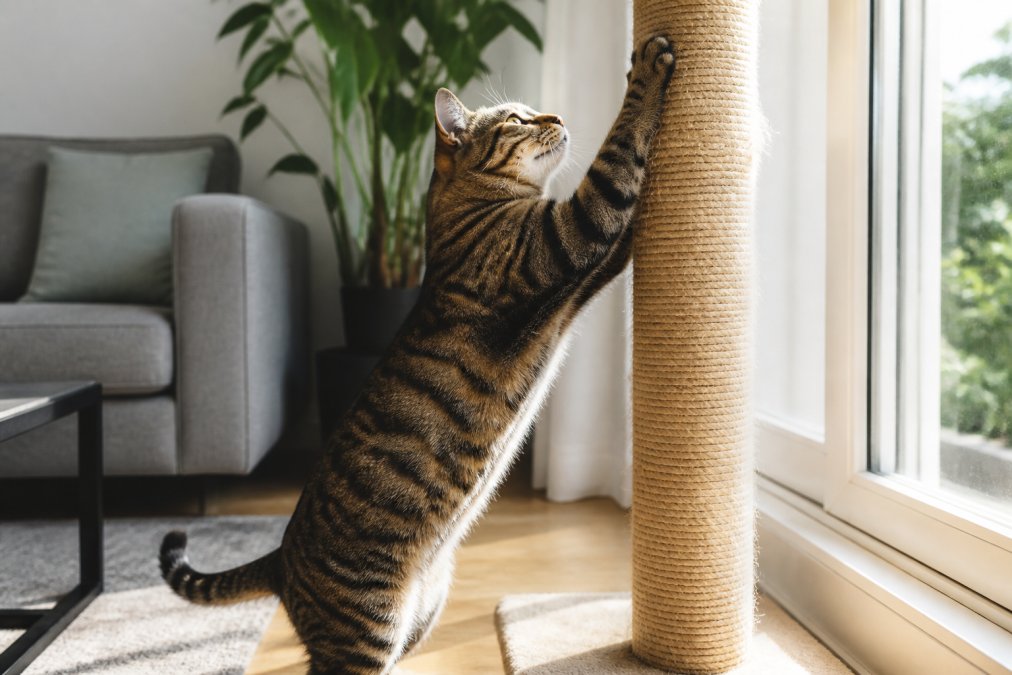
Vertical scratching posts are the most common format and suit the majority of cats. They replicate the experience of scratching a tree trunk: the cat stretches upward, engages its back and shoulder muscles, and drags its claws down the surface. A good vertical cat scratching post should be tall enough for your cat to fully extend, which we'll cover in the height section below.
Cat towers combine a vertical scratching post with elevated platforms, giving cats a vantage point as well as a scratch surface. For indoor cats with limited environmental enrichment, a cat tower addresses multiple needs at once: claw maintenance, climbing, observation, and rest. The scratching column is typically wrapped in sisal rope, while the platforms are often carpeted for comfort.
Horizontal Scratchers and Scratch Pads
Some cats are natural horizontal scratchers. You'll recognise them by their preference for scratching carpet, rugs, or the base of furniture rather than the sides. A horizontal scratcher or scratch pad placed flat on the floor suits these cats far better than a vertical post.
Cardboard scratch pads are the most common horizontal format. They're lightweight, inexpensive, and many cats take to them immediately. The texture of corrugated cardboard provides satisfying resistance without being too aggressive on the claws.
Horizontal scratchers are also a practical addition for multi-cat households, where different cats may have different scratching preferences.
Multi-Level Cat Trees and Activity Centres
Multi-level cat trees are the most comprehensive solution for indoor cats. They function as a cat activity centre: combining vertical scratching columns, horizontal platforms, hammocks, tunnels, and often dangling toys. For cats that spend most of their time indoors, a well-designed cat tree provides the kind of environmental complexity that keeps them physically and mentally engaged.
The trade-off is size and price. A quality multi-level cat tree takes up floor space and costs more than a basic post. For a single cat in a small flat, a tall vertical post may be the more practical choice. For households with two or more cats, a multi-level structure often pays for itself by reducing territorial conflict.
| Format | Best For | Key Benefit |
|---|---|---|
| Vertical post | Most cats | Full-body stretch, claw maintenance |
| Horizontal scratcher / pad | Carpet scratchers | Matches natural low scratching posture |
| Cat tower | Single indoor cats | Combines scratching, climbing, resting |
| Multi-level cat tree | Multi-cat households | Multiple scratch points, reduces conflict |
Sisal vs Carpet Cat Scratcher: Which Material Lasts Longer?
Sisal rope and carpet are the two most common covering materials for a cat scratching post, and they're not equally durable or effective.
Sisal rope is the clear winner for most cats. It's a natural fibre derived from the agave plant, and its coarse, fibrous texture is highly satisfying to cats. Sisal rope handles prolonged, heavy scratching without compressing or matting, which means it maintains its resistance and texture over time. It's also a more sustainable material choice than synthetic carpet, as it's biodegradable and plant-derived.
Carpet-covered posts are softer and initially appealing to some cats, but they degrade faster under regular use. The fibres mat down, reducing the tactile feedback cats are seeking. There's also a practical risk: carpet-covered posts can train cats to scratch carpet in general, since the texture is identical. If you have carpeted floors and a cat with scratching habits, a sisal rope post is the safer choice.
Cardboard and Eco-Friendly Options
Cardboard scratch pads have grown in popularity as an eco-friendly option. Most are made from recycled corrugated cardboard, and the material is compostable at end of life. According to sustainability guidance from the Australian government's environment department, choosing products made from recycled or natural materials reduces landfill contribution, which makes cardboard scratchers a genuinely lower-impact choice.
The limitation of cardboard is longevity. A heavily-used cardboard pad may need replacing every few weeks, which offsets some of the environmental benefit if you're buying frequently. For eco-conscious owners, a durable sisal rope post used for several years is likely the more sustainable option overall.
Cat Scratching Post Height Requirements Explained
Cat scratching post height requirements are straightforward: the post must be tall enough for your cat to fully extend its body when scratching. For most adult cats, this means a minimum height of 60-70 centimetres. Large breeds such as Maine Coons or Ragdolls may need posts closer to 90 centimetres.
The reason height matters is functional. If a cat can't fully stretch while scratching, it doesn't get the muscular benefit of the motion. A post that's too short is the equivalent of a human being forced to do a bicep curl at half range. Cats sense this quickly and lose interest.
A common mistake is buying a post sized for a kitten and not replacing it as the cat grows. What works at 12 weeks will be inadequate at 12 months. If your adult cat is scratching the top of the sofa arm rather than the post, height is almost certainly the issue.
The post also needs a non-slip base. A post that wobbles or tips when a cat applies full weight will be abandoned immediately. Cats test stability before committing to a scratch surface. A heavy-duty base, or a post designed to be wall-mounted, eliminates this problem entirely.
How to Train a Cat to Use a Scratching Post
Training a cat to use a scratching post is less about obedience and more about making the post the most attractive option available.
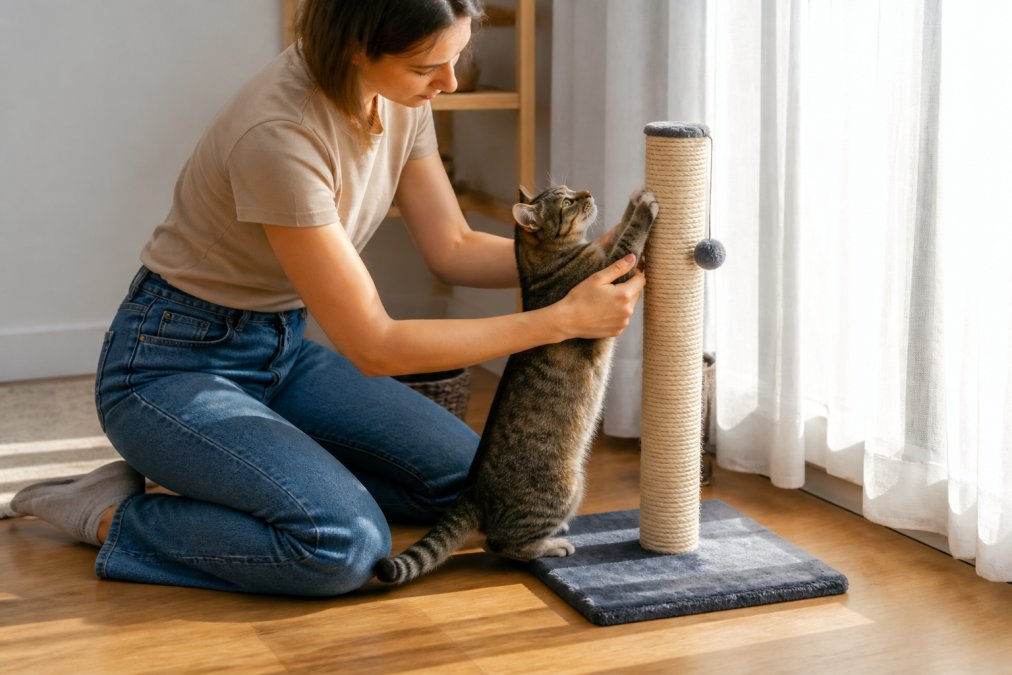
Most cats don't need extensive training if the post is positioned correctly and the material suits their preference. The process is largely about introduction and reinforcement. According to International Cat Care's behaviour guidance, positive reinforcement is the most effective method for encouraging cats to use designated scratch surfaces. Punishment for scratching furniture is counterproductive and increases anxiety.
Placement Strategy for Maximum Usage
Placement is the variable most guides skip over, and it's the one that makes or breaks post adoption.
Cats scratch most frequently after waking and near areas they consider their territory. Place the cat scratching post in the room where your cat spends the most time, not in a back room or out-of-the-way corner. Cats won't walk across the house to use a post; they'll use whatever is nearest when the urge strikes.
Positioning near sleeping spots is particularly effective. A vertical post beside the cat's bed or favourite chair intercepts the post-nap scratching behaviour before it reaches the furniture. Similarly, placing a post near entry points or windows addresses territorial marking instincts directly.
For multi-cat households, multiple posts in different locations reduce competition and territorial stress. One post per cat, plus one extra, is a practical guideline.
Protecting Furniture While Training
Furniture protection during the training period requires a two-part approach: making the post more attractive and the furniture less so.
Double-sided tape applied to furniture surfaces cats are targeting creates an unpleasant texture without causing harm. Temporary furniture covers or deterrent sprays can reduce access during the initial weeks. At the same time, rubbing a small amount of catnip onto the new cat scratching post increases its appeal immediately for cats that respond to it.
Reward-based reinforcement works well. When your cat uses the post, offer a treat or verbal praise immediately. The timing matters: the reward needs to come within a few seconds of the scratching behaviour, not after the cat has wandered off.
Stability, Safety and Multi-Cat Household Considerations
Post stability is non-negotiable for cat welfare and post adoption. A cat scratching post needs a base that won't shift, tip, or rock when a cat applies full bodyweight during a stretch. Heavy-duty bases, wide footprints, and wall-mounted designs all address this. For large or heavy cats, a post with a weighted base or one that can be bolted to a wall stud is the most reliable option.
Reinforced construction matters in multi-cat households especially. When multiple cats use the same post, the wear rate increases significantly and structural integrity becomes a safety consideration. Look for posts where the sisal rope is tightly wound and secured at both ends, and where the platform joints are bolted rather than just glued.
Multi-cat households also benefit from thinking about vertical space differently. Cats establish social hierarchies partly through height: higher positions signal dominance. A multi-level cat tree that offers platforms at different heights gives each cat a position that suits its place in the group, reducing conflict around the scratch surface itself. Cat enrichment in a multi-cat home is as much about spatial management as it is about individual products.
For kittens and senior cats, post height and texture need adjustment. Kittens benefit from lower entry points and softer sisal; senior cats with joint stiffness may prefer horizontal scratchers that don't require upward extension.
Pet Care Online stocks many cat scratching posts, cat towers, and multi-level cat trees suited to different breeds, household sizes, and budgets, with delivery available across Australia.
Frequently Asked Questions
Q: Are scratching posts essential for indoor cats?
A: Yes. Indoor cats have no outdoor surfaces to scratch, so a cat scratching post is the primary outlet for their natural scratching behaviour. Without one, cats redirect to furniture, carpet and curtains. A good post supports claw maintenance, stress relief and territorial marking, all behaviours that are hardwired into feline behaviour regardless of whether a cat lives indoors or outdoors. Providing at least one post per cat is the baseline recommendation for cat wellness.
Q: What material is best for a cat scratching post?
A: Durable sisal rope is widely considered the best material for a cat scratching post. It gives cats the satisfying resistance they seek, holds up to heavy daily use, and does not snag claws the way looped carpet fibres can. Cardboard scratchers are a good secondary option and appeal to cats that prefer horizontal scratching. Carpet-covered posts work for some cats but tend to wear faster and can encourage scratching on household carpet.
Q: How tall should a cat scratching post be?
A: A cat scratching post should be tall enough for your cat to fully extend its body during a vertical scratch, generally at least 60-70 cm for an average adult cat. Posts shorter than this force cats into a hunched position, which reduces the stretch benefit and often means they'll ignore the post in favour of a taller surface like a doorframe or couch arm. Always measure your cat from nose to tail base when fully stretched before choosing a post height.
Q: Where is the best place to put a cat scratching post?
A: Place a cat scratching post where your cat already spends time or near spots they currently scratch. Common effective locations include beside the sofa, near sleeping areas (cats scratch after waking), and close to entry points they use regularly. Cats scratch partly to mark territory visually and with scent, so tucking a post in a hidden corner reduces the chance they'll use it. Visibility matters, if the post is in their territory, they're more likely to scratch it.
Finding the right cat scratching post takes a little more thought than grabbing the nearest option, but the payoff is a cat that uses it consistently and furniture that stays intact. Pet Care Online carries scratching posts in every format, from simple sisal rope vertical posts to full multi-level cat trees, with the range to suit kittens, large breeds, and multi-cat households alike. Shop the cat scratching post range at Pet Care Online and get everything delivered directly to your door.
This article was written using GrandRanker